
That familiar 2.9% + 30 cents number can fool you. Stripe, a payment service provider that often advertises flat-rate pricing, presents these standard transaction fees as a benchmark. For most SaaS businesses, the real cost of taking payments is higher, and sometimes much higher.
If you're a finance lead, controller, or RevOps owner, you need the rate that shows up in actual reporting, not marketing copy. That's where the effective stripe fee rate matters, because it reflects your real payment mix, refund activity, and cross-border exposure.
Why the effective Stripe fee rate matters more than the headline rate
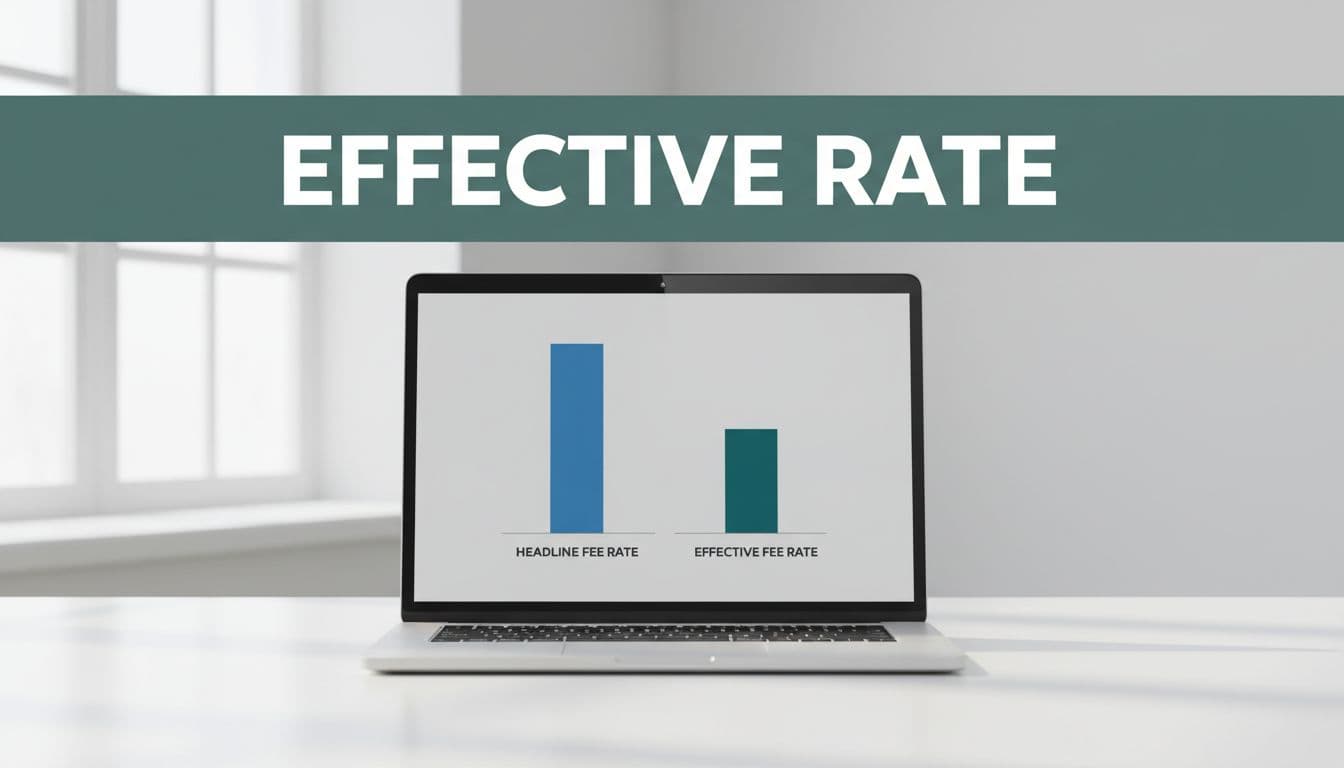
Think of Stripe's posted fee like a sticker price. Your effective rate is the out-the-door cost.
As of March 2026, Stripe's standard transaction fees for domestic card transactions in the US are still 2.9% + 30 cents. International cards add 1.5%, ACH direct debit is 0.8% capped at $5, currency conversion fee adds 1%, dispute fee costs $15, refunds usually don't add a new fee, but Stripe keeps the original processing fee, and there are usually no setup fees for standard accounts. A current 2026 Stripe fee breakdown is helpful for a quick reference.
For SaaS teams, that means the headline rate is only the starting point. Your blended result changes based on billing cadence, transaction size, customer geography, payment method mix, refunds, and disputes.
Use this core formula:
Effective Stripe fee rate = Total Stripe fees for the month / Total successful payment volume for the month
That formula works, but the numerator and denominator must stay consistent, where successful transaction volume defines the denominator precisely. If you change one and not the other, the metric gets noisy fast.
This table keeps the distinction clean:
| Metric | Formula | Best use |
|---|---|---|
| Headline fee rate | Posted Stripe pricing | Vendor pricing reference |
| Effective fee rate | Total payment-related Stripe fees / successful payment volume | Operating metric for finance |
| All-in Stripe cost rate | All Stripe fees, including payouts or add-ons / successful payment volume | Wider margin view |
The main takeaway is simple: headline pricing is not reporting reality.
The most common mistake is dividing fees by net revenue after refunds. That mixes payment cost with revenue policy and makes trend lines harder to trust.
How to calculate it in a monthly SaaS reporting model
A solid model starts with the right source data. Pull Stripe balance transactions plus charge-level details. Then build one monthly table that ties back to your ledger.
For operating analysis, many teams use the charge date. For cash tie-out, use payout timing. Keep those views separate, because one explains unit economics and the other explains bank movement.
A practical monthly model should include these fields:
- Transaction basics: date, customer, invoice, amount, currency, country, payment method, and plan cadence.
- Fee drivers: base processing fee, international surcharge, cross-border fee, dispute fee, refund-related retained fee, payout fee, and any product or add-on fee bucket.
- Business flags: new sale, renewal, annual prepay, recovered dunning payment, refund, and chargeback.
High-volume businesses need this granularity to precisely track costs.
Then calculate three totals each month: successful transaction volume, payment processing fees, and all Stripe fees.
Here is a clean example. Say your SaaS company processes $500,000 in successful transaction volume. Stripe fees break out like this:
- Standard transaction fees: $13,900
- International card surcharges: $1,450
- Cross-border fee: $300
- Refund-related retained fees: $110
- Dispute fees: $240
That gives you $16,000 in payment processing fees.
So the effective stripe fee rate is:
$16,000 / $500,000 = 3.20%
If you also include payout fees and Stripe Connect worth another $700, your all-in Stripe cost rate becomes 3.34%.
That difference matters. The first rate helps you manage standard transaction fees; the second helps you explain total platform cost.
If you want a quick sanity check while building the model, a simple US Stripe fee calculator can help test assumptions before you finalize your reporting logic.
Why SaaS companies see the rate move, and how to lower it
SaaS payment mix in recurring billing changes more than most teams expect. A month with more annual prepayments or digital wallets often shows lower effective payment processing fees, because the fixed 30¢ fee gets spread over larger charges. On the other hand, small monthly subscriptions push the payment processing fees up.
Renewals matter too. Mature cohorts can have lower fees if they skew domestic and low-risk. Yet a wave of international expansion can lift the rate quickly, since international cards add 1.5%, and FX can add another 1%.
Refunds and disputes also hit harder than they look. A refund reverses revenue, but not the original processing cost. A chargeback adds chargeback fees, so even a few cases can distort a low-ARPU product line.
Involuntary churn deserves its own flag in the model. Failed renewals usually don't create normal processing fees, but recovered payments can change your mix later in the month. Track recovered renewals separately so you can see whether dunning improves collected revenue without hiding fee drag.
Alternative payment methods can help. ACH direct debit is often cheaper for large invoices, because 0.8% capped at $5 can beat card pricing by a wide margin. Local methods may also improve authorization and reduce international card use. ACH direct debit works especially well for cost savings on domestic recurring payments. For businesses blending online and offline sales, Stripe Terminal enables in-person payments with potentially lower costs than card-not-present transactions. If you're reworking packaging, Stripe's own usage-based SaaS pricing guide is useful context because billing design affects transaction count and ticket size. Negotiating volume discounts, custom pricing, or interchange-plus pricing can provide alternatives to flat-rate pricing models.
Finally, decide where platform and add-on fees belong. Stripe Billing, Stripe Radar, payout fees, fraud tools, or other extras may belong in a wider Stripe cost view, not your payment-only effective fee rate. Keep both metrics, and you won't lose the story.
If you're benchmarking payment stack choices, a broader processor comparison for SaaS companies can help frame whether the issue is Stripe itself or your current mix.
The metric gets useful when it drives action
The effective stripe fee rate becomes valuable when you can explain what moved it. High-volume businesses and non-profit organizations often face different needs around standard transaction fees based on their payment mix. If the rate jumps, you should know whether the cause was more small-ticket renewals, more foreign cards (especially for global startups using Stripe Atlas), refunds, disputes, product add-ons, or wire transfers.
Build the monthly model once, segment it by fee driver including wire transfers, and review it like any other margin metric. The companies that keep more gross profit usually don't guess on fees; they measure them, with the effective stripe fee rate serving as the true test against the 2.9% + 30 cents sticker price for payment processing fees.