
That familiar 2.9% + 30¢ number tells only part of the story. For subscription SaaS, stripe billing fees sit on top of core payment processing, and that extra layer changes your real margin.
If you're a founder or finance lead, the main job is simple: separate the fee for charging a card from the fee for running recurring billing. Once you do that, the Stripe fee breakdown gets much easier to model.
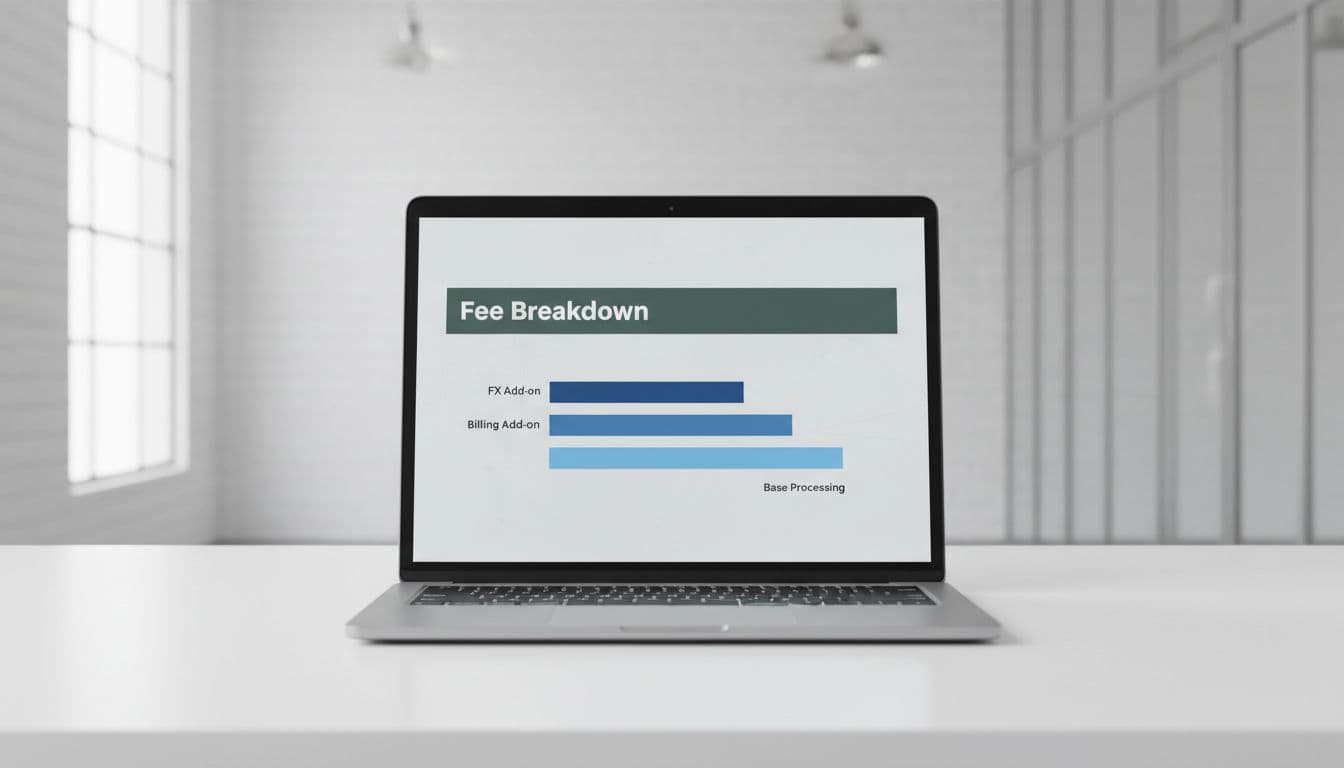
What Stripe Billing fees actually include
As of April 2026, Stripe's standard US online card rate is 2.9% + 30¢ per successful domestic transaction, according to Stripe's pricing page. That is the core payment fee. It applies whether the payment is a one-time purchase or a subscription renewal.
Stripe Billing is different. On Stripe's pay-as-you-go Billing pricing, the add-on is 0.7% of Billing volume, as shown on Stripe Billing pricing. That covers recurring billing tools like subscription schedules, proration, and metered billing logic. Stripe also offers monthly contract plans and custom pricing, so your rate may differ by volume, region, or negotiated terms.
Here is the cleanest way to think about it:
| Fee layer | Typical US pay-as-you-go rate | What it covers |
|---|---|---|
| Core card processing | 2.9% + 30¢ | Successful online card payment |
| Stripe Billing add-on | 0.7% of Billing volume | Recurring subscriptions, proration, usage-based billing |
| Common extra charges | +1.5% international cards, +1% FX, $15 disputes | Cross-border, currency conversion, chargebacks |
That Stripe fee breakdown matters because the fixed 30¢ hits low-ticket plans hard. On a $10 monthly seat, the fixed fee alone eats 3% before the percentage fee or Billing add-on. On a $300 annual plan, the same 30¢ barely registers.
Regional pricing also shifts the picture. For example, Stripe lists different domestic rates in places like the EEA, New Zealand, and Mexico. Some regions also carry higher FX surcharges. The Stripe processing fees SaaS teams budget for can therefore miss the real number once international customers enter the mix.
Common SaaS scenarios, with simple cost examples
A Stripe fee calculator is useful for spot checks, but subscription math gets clearer with a few common cases. These examples use standard US card pricing and Stripe Billing pay-as-you-go pricing.
| Scenario | Charge amount | Processing fee | Billing fee | Total fee | Effective rate |
|---|---|---|---|---|---|
| Monthly subscription | $30 | $1.17 | $0.21 | $1.38 | 4.60% |
| Annual subscription | $300 | $9.00 | $2.10 | $11.10 | 3.70% |
| Metered billing invoice | $120 | $3.78 | $0.84 | $4.62 | 3.85% |
| One-off invoice paid by card | $1,200 | $35.10 | Usually excluded on Billing pay-as-you-go | $35.10 | 2.93% |
The pattern is easy to miss at first. Monthly plans often carry the highest effective rate because the fixed 30¢ gets repeated every cycle. Annual plans usually lower the blended percentage, even when the charge amount is much larger.
Metered billing sits somewhere in the middle. If usage rolls into larger monthly totals, the fixed fee becomes less painful. If customers generate many small invoices, your SaaS payment processing costs can climb fast.
One more detail matters here. Stripe says the 0.7% Billing fee excludes one-off invoices on its pay-as-you-go Billing pricing. So if your SaaS mixes subscriptions with manual invoicing, recurring revenue and invoice revenue may carry different fee profiles.
The headline rate is rarely your real rate. For SaaS, frequency, ticket size, and customer geography change the math more than most teams expect.
Failed payments add another wrinkle. Stripe does not list a separate failed-charge fee here, but any recovered payment still incurs normal processing fees once it succeeds. The finance impact is broader than the fee itself, because retries, churn risk, and support time all stack up.
The overlooked costs, and how to reduce Stripe fees
When teams ask how to reduce Stripe fees, the answer usually starts with mix, not negotiation. Hidden costs tend to come from international cards, currency conversion, disputes, and add-on tooling.
A US SaaS company may pay the base 2.9% + 30¢, then add 1.5% for an international card and 1% for currency conversion. One charge can move from normal to expensive in seconds. Disputes add $15 each, win or lose, which makes low-ARPU plans especially painful.
Tax and billing tools matter too. If you use extra products for tax collection, invoicing workflows, or recovery automation, those costs may not appear inside core Stripe fees, but they still affect margin. That is why Stripe fees should be reviewed as a full operating cost, not as a single line item.
A quick look at Stripe vs PayPal fees also shows why headline pricing alone can mislead. For subscription businesses, billing logic, dunning, and global payment support often matter as much as the base percentage.
The practical fixes are usually straightforward. Push eligible larger accounts to ACH where it fits, since ACH Direct Debit is often cheaper at 0.8%, capped at $5. Encourage annual prepay where your sales motion supports it. Reduce failed renewals with better card updater and retry strategy. If volume is high enough, ask Stripe about custom pricing.

For transaction-level visibility, FeeTrace's Stripe fee optimization tools help show where your effective rate rises by card type, country, and payment mix. You can also see how FeeTrace works, or go straight to Analyze My Fees if you want to measure your real blended rate.
The core point is simple: stripe billing fees are not the same as payment processing fees. If you budget only around 2.9% + 30¢, your forecast will often miss what subscriptions, cross-border volume, and retries actually cost.
Measure the full stack, not the headline. Once you see the true effective rate, the path to lower fees becomes much easier to act on.