
That first Stripe rate on the pricing page is rarely your full cost. If your SaaS sells across borders with Stripe Billing, one subscription can pick up extra payment processing fees that don't show in a simple margin model.
That's why Stripe international fees matter most when you scale outside one home market via your merchant account. The base processing fee is only layer one. After that, cross-border surcharges and currency conversion can push your effective rate much higher due to Stripe international fees.
The three fee layers behind a global Stripe charge
Start with the standard processing fee. This is the base rate for a successful transaction using online card payments, and it depends on your Stripe account country, payment method, and pricing plan such as flat-rate pricing or interchange-plus pricing and custom pricing for large-scale users (volume discounts are possible for established companies). As of March 2026, standard published rates still vary by market, with US accounts commonly starting at 2.9% + 30¢ for online card payments, while UK and many EU accounts show lower local-card rates with different fixed fees on the Stripe pricing page.
Next comes the international or cross-border surcharge. This usually applies when the customer's card was issued outside your account's country, or outside your local pricing zone. For US accounts, published add-ons are commonly around 1.5%. In Europe, the spread can depend on whether the card is from the EEA, the UK, or outside both.
Then there's the FX markup, also called FX fees or the currency conversion fee. This is separate from the cross-border charge. If you bill in one currency and Stripe settles in another, Stripe may add a currency conversion fee. Current public guidance and recent pricing references put that at about 1% for common US flows, while some UK and EU setups can be higher. Stripe's own processing fee guide is useful for understanding how these layers work.
A single international SaaS payment can carry base processing, a cross-border surcharge, and FX at the same time.
One more wrinkle matters for operators. Stripe hasn't announced a broad 2026 fee reset for international card processing, but country-specific pricing and custom contracts still change the outcome. So don't assume your US rate matches your UK entity, or that your quoted rate applies to every payment type.
What actually triggers Stripe international fees
The fee logic is easier once you isolate the triggers for cross-border transactions versus domestic card transactions. Stripe mostly looks at your account country, the card's issuing country, the payment method, and whether currency conversion happens. A customer's IP address or billing address may affect Stripe Radar and fraud protection, but they usually don't drive the fee stack by themselves.

Take a simple case of a successful card-not-present transaction. A US-based SaaS company charges a German customer $100 in USD using a German-issued card. That successful transaction will likely pick up the base US card fee plus the international card fee. However, Stripe usually won't charge FX on that transaction, because the charge and settlement both happen in USD. The customer's bank may convert the amount later, but that's not your Stripe cost.
Now change one variable. The same customer pays €100, and your Stripe account settles to USD. In that case, the payment can carry all three layers: base fee, cross-border surcharge, and FX markup.
A rough calculation shows why finance teams care. On a $100 domestic card transaction, your variable fee is often about $2.90, before the fixed 30¢. On a $100 international charge with conversion, that can move closer to $5.40, again before the fixed fee. Same subscription value, very different margin.
If you want a plain-English outside explanation of this stacked model, this layered fee breakdown matches what many SaaS teams see in practice.
A quick comparison for SaaS pricing models
For SaaS, small fee differences get amplified by volume in recurring billing and renewals. A few extra points on one invoice may not hurt. A few extra points across thousands of renewals can quietly reset your gross margin target.
This simplified table uses common March 2026 published rates for standard pricing, including country-specific rates for US, UK, and EU setups. Your country, contract, card mix, and settlement setup can change the actual total.
| Setup | Likely fee layers | Approx total before fixed fee |
|---|---|---|
| US account, US card, USD billed and settled | Base only | ~2.9% |
| US account, UK card, USD billed and settled | Base + international | ~4.4% |
| US account, EU card, EUR billed, USD settled | Base + international + FX | ~5.4% |
| EU account, EEA card, EUR billed and settled | Local base only | Often ~1.5% |
| UK or EU account, non-local card, conversion needed | Base + international + FX | Often 4%+ |
| US-based ACH direct debit for recurring billing | ACH only | ~0.8% |
| Enterprise wire transfers | Wire processing | Varies, often 1%+ equivalent |
| Digital wallets (Apple Pay, Google Pay, etc.) | Base + wallet surcharge | ~3.0-3.5% |
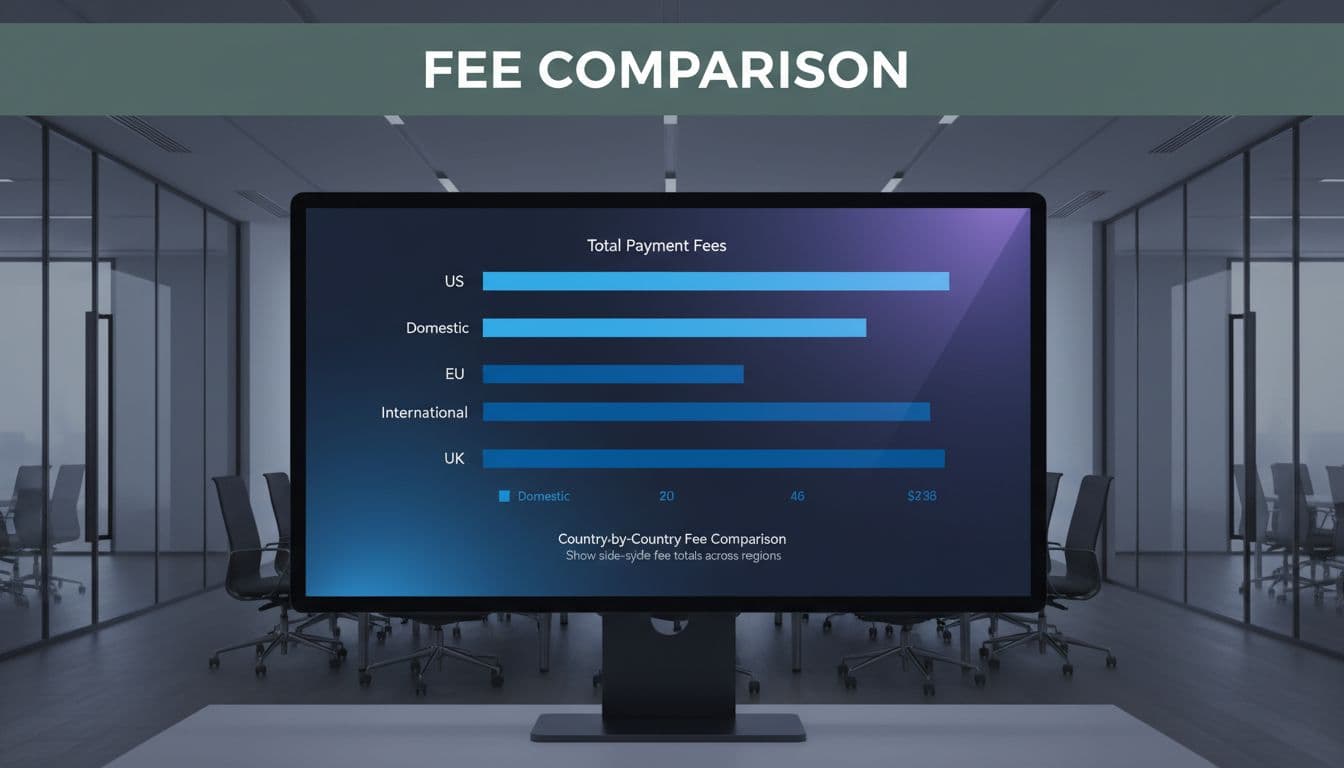
Alternative payment methods like ACH direct debit can deliver much lower costs for US recurring billing, while wire transfers suit larger enterprise setups and digital wallets add convenience with moderate surcharges.
Here's what that means in a real subscription model. Say you charge $49 per month, and 700 of your monthly renewals are international payments that also require conversion. Using the rough spread above, you might pay about $2.95 per converted charge instead of $1.72 on a domestic one. That's about $1.23 extra per payment, or roughly $860 per month. Over a year, that gap can cross $10,000.
That's why SaaS teams shouldn't budget from a headline Stripe rate alone. The useful metric is your effective rate of payment processing fees by segment, broken out by card country, billing currency, and settlement currency.
Keep the fee stack visible
Stripe international fees aren't random. They're layered, and each layer answers a different question: where the card came from, what currency you charged, and where the money settles. This applies whether you're using Stripe Connect for marketplace-style SaaS or Stripe Terminal for physical touchpoints.
Once you separate those layers, pricing decisions get clearer. You can test local entities, compare local payment methods, and see when multi-currency setup is worth the effort, while accounting for extras like dispute fees, chargeback protection, refund fees, and setup fees.
Audit one recent month of international invoices and group them by fee driver, including wire transfers. The margin leak, often tied to FX fees, usually shows up fast.