
Every extra renewal costs money. For SaaS on Stripe, the biggest drag in monthly billing is often the flat fee attached to each successful charge.
Annual plans don't change Stripe's headline rate. They lower your effective fee rate because you collect one larger payment instead of 12 smaller ones. That can also reduce failed-payment events and improve cash flow.
If you're reviewing annual billing Stripe fees, the math is simpler than it looks. Start with the fee structure, then decide if annual fits your customers.
The monthly versus annual fee math
As of April 2026, Stripe's standard U.S. online card rate is 2.9% + 30¢ per successful domestic charge, and Stripe Billing adds 0.7% of subscription volume, based on this 2026 Stripe Billing fee guide. Pricing can change, and fee structures vary by country, payment method, and card mix.
For SaaS teams, that means the percentage fee scales with revenue, but the fixed 30¢ fee multiplies with billing frequency. That's why smaller monthly plans often produce higher effective Stripe fees than an equivalent annual plan.
Here's a simple example using the same $360 in yearly revenue per customer.
| Billing cadence | Charges per year | Revenue | Fixed fees | Total Stripe fees | Effective rate |
|---|---|---|---|---|---|
| $30 monthly x 12 | 12 | $360.00 | $3.60 | $16.56 | 4.60% |
| $360 annual x 1 | 1 | $360.00 | $0.30 | $13.26 | 3.68% |
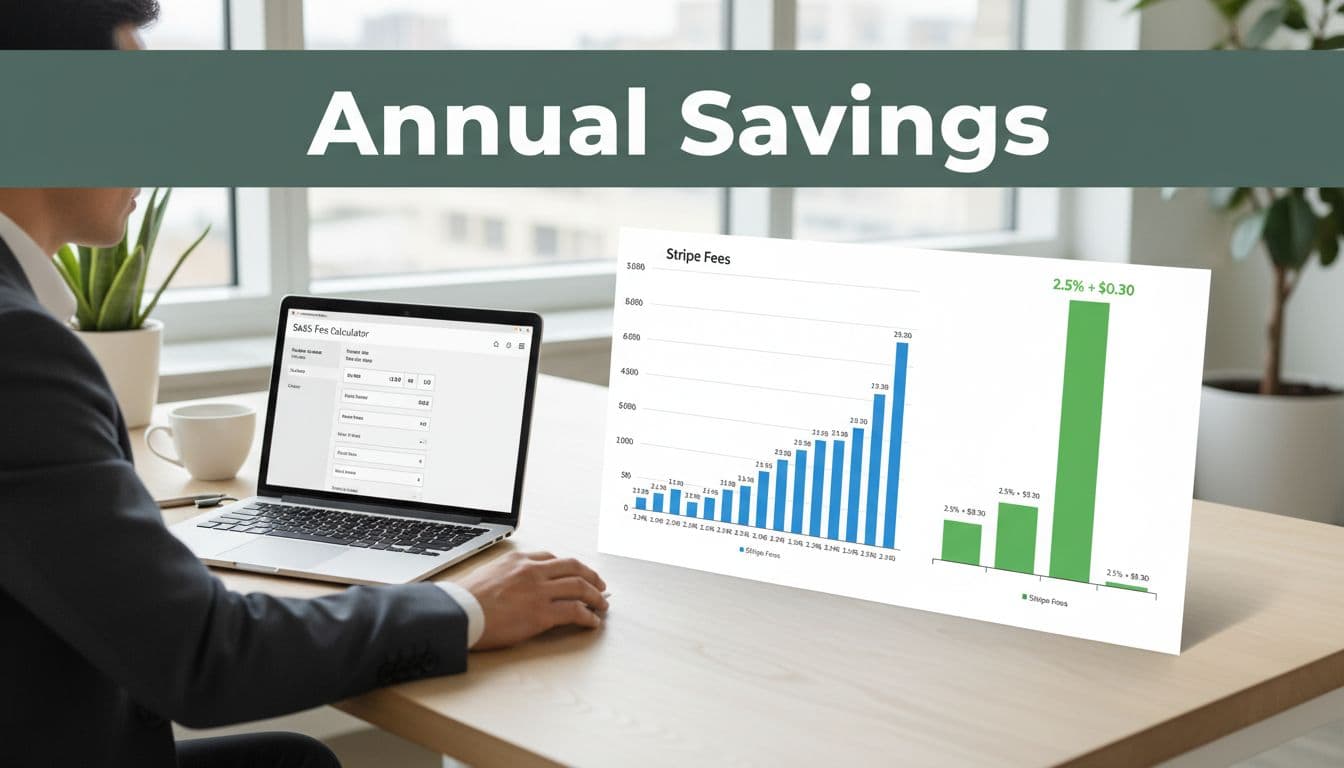
The takeaway is clear. Annual billing saves $3.30 per customer per year in this example, and almost all of that comes from avoiding 11 extra fixed fees. The percentage-based part of the Stripe fee breakdown stays the same on equal revenue. The Billing percentage stays tied to volume too.
Annual billing lowers effective Stripe fees mainly by cutting repeated fixed charges, not by changing Stripe's percentage rate.
That may sound modest, but scale changes the story. At 10,000 customers, the same shift can save about $33,000 a year before any annual-plan discount. A basic Stripe fee calculator is useful for a first pass, and a broader 2026 Stripe fees explainer can help you sanity-check the inputs. Still, the real Stripe processing fees SaaS teams pay depend on card mix, geography, disputes, and payment method.
The extra gains, and the limits, behind annual billing
Fee reduction is the main point here, but annual billing changes the rest of the subscription engine too. Monthly plans create 12 renewal moments every year. Annual plans create one. So you get 11 fewer chances for expired cards, issuer declines, and retry flows to interrupt revenue.
That matters because fewer renewal attempts often mean fewer failed-payment events and lower involuntary churn risk. Your team also spends less time on dunning and fewer cycles explaining lost renewals to finance or leadership. In addition, cash flow improves because you collect more upfront.
Still, annual isn't always the better choice. One failed annual renewal hurts more because the contract value is larger. On top of that, a big annual discount can erase the fee savings if you aren't careful. If you give up 20% in price to save less than 1 percentage point in processing cost, the fee win is no longer the main story.
So where does annual work best? Usually with products that show value fast, keep customers for a long time, and fit budget cycles well. B2B SaaS with stable usage is the classic case. On the other hand, early-stage tools with weak activation or seasonal demand should be careful.
If you're comparing Stripe vs PayPal fees, cadence still matters because fixed fees hit low-ticket subscriptions hardest. This 2026 payment processor pricing comparison is a useful starting point. For your own SaaS payment processing costs, though, transaction-level data is far better than a blended dashboard. That's where FeeTrace deep fee breakdowns for SaaS help.
How to test annual plans without hurting conversion
If you're asking how to reduce Stripe fees without changing processors, annual billing is one of the cleaner tests. But test it with care.
Keep monthly and annual side by side at first. A modest annual discount, often 10% to 15%, is easier to absorb than a steep cut. Then test the default selection, plan copy, and placement of the annual offer. Many SaaS teams see better results when they introduce annual after activation, not on day one.
Watch more than signup conversion. Measure paid conversion, first-year retained revenue, failed-payment rate, refund rate, and effective fee rate. That gives you the full picture, not just top-line bookings.
Use real billing data instead of guesses. A spreadsheet can model the flat-fee savings, but it won't show the mix of international cards, wallet usage, or dispute costs hiding inside your Stripe fee breakdown. For that, see how FeeTrace analyzes Stripe fees, then Analyze My Fees against your last 60 to 90 days of subscription charges.

Annual billing won't solve every margin problem. But when the product fits and retention is healthy, it turns 12 fixed-fee hits into one, which is why the effective rate drops.
For many SaaS teams, that's the simplest path to lower Stripe fees without changing payment rails. Model the savings, test the offer carefully, and let your own renewal data decide.