You're running a subscription-based B2B SaaS business. Stripe handles your payments. But those Stripe fees add up fast. A typical setup means 2.9% plus $0.30 per charge. Add invoicing or international cards, and payment processing fees climb to 4% or more.
Many SaaS owners overlook small tweaks. Invoice consolidation changes that. It combines multiple bills into one. You pay fewer flat fees. Your effective rate drops.
This post shows exactly how it works. You'll see real numbers and steps to apply it.
Break Down Your Stripe Fees First
Stripe's base rate looks simple: 2.9% + $0.30 for US cards. But Stripe processing fees SaaS teams face go beyond that. Invoicing adds 0.4% per paid invoice, capped at $2. International payments tack on 1.5%. Currency conversion? Another 1%.
Here's a quick view of common components.

For a $100 monthly invoice, you pay $3.20 base. Send 12 small ones over a billing period? That's $3.60 extra in flat fees alone from multiple transactions. SaaS payment processing costs like these eat margins. A $100K/month processor might lose $4,230 total, per recent data.
Use a Stripe fee calculator to check your mix. It factors payment type and location. Most show your true rate exceeds the ad, which is where consolidated invoicing comes in as a solution to high effective rates.
How Invoice Consolidation Works
Invoice consolidation, or consolidated billing, merges several charges into a single invoice. Think monthly subscriptions plus add-ons. Instead of separate payments, customers settle once.
Stripe supports this via Billing. You group line items by billing cycle in your billing system. Customers get one statement with an itemized breakdown. One due date. One payment.

Why does it help? Each transaction hits the $0.30 flat fee. Stripe invoicing fees apply per invoice too. Fewer invoices mean fewer hits. Stripe's guide on billing consolidation explains the setup.
For B2B SaaS, it fits annual plans or usage overages. Customers prefer simplicity. You cut admin time. Revenue recognition stays the same.
Calculate Savings from Fewer Transactions
Start with numbers. Suppose a customer has $500 annual spend. Broken into multiple transactions as 12 $42 invoices: 12 x $0.30 = $3.60 flat fees. Plus 0.4% invoicing: about $2.40 more.
Switch to consolidated invoicing with a single invoice for $500: $0.30 flat + $2 invoicing cap. Total under $2.40. You save over $3.60 yearly per customer.
Scale it. 1,000 customers? That's $3,600 back in your pocket.
| Scenario | Invoices | Flat Fees | Invoicing Fees | Total Extra |
|---|---|---|---|---|
| Monthly separate | 12 | $3.60 | $2.40 | $6.00 |
| Consolidated | 1 | $0.30 | $2.00 | $2.30 |
This table ignores base processing. It shows extras only. Savings grow with volume, helping capture volume discounts while minimizing per-transaction drag. For high-ACV B2B, push annual consolidations.
Tools like Maxio handle this automatically. Their invoice consolidation post details B2B examples.
Real-World Savings for B2B SaaS
B2B SaaS often bills usage-based charges (involving prorating), seats, and add-ons separately. That multiplies fees and creates billing noise. Consolidated billing groups these prorated charges together.
Take a $10K MRR business. 200 customers average $50/month. Without consolidation, 200 monthly transactions: $60 flat fees. Consolidate to quarterly: 50 transactions/quarter or 200/year. Halve the flats to $30 quarterly. This invoice consolidation also improves the customer experience by reducing invoice clutter.

Effective rate drops 0.2-0.5%. On $120K ARR, that's $240-$600 saved. Stack with ACH pushes for more. FeeTrace's guide on Stripe invoicing fees notes flats dominate small bills.
How to reduce Stripe fees starts here. Test on top customers first. Track uptake.
Combine with Other Fee Reducers
Consolidation pairs well with basics. Encourage ACH (0.8% vs 2.9%), which simplifies accounts payable for clients when combined with fewer invoices. This reduces administrative overhead for both parties and simplifies overall billing management. Offer annual discounts. Localize for internationals.
Stripe vs PayPal fees? Stripe wins on APIs, but PayPal charges 3.49% + $0.49. Stick with Stripe, optimize inside.
How to reduce Stripe fees covers mixes like these. Full Stripe fee breakdown reveals payment method drags.
Monitor Fees for Ongoing Wins
Savings stick if you watch them. Dashboards break fees by invoice count, method, geography, enabling strong financial reporting.
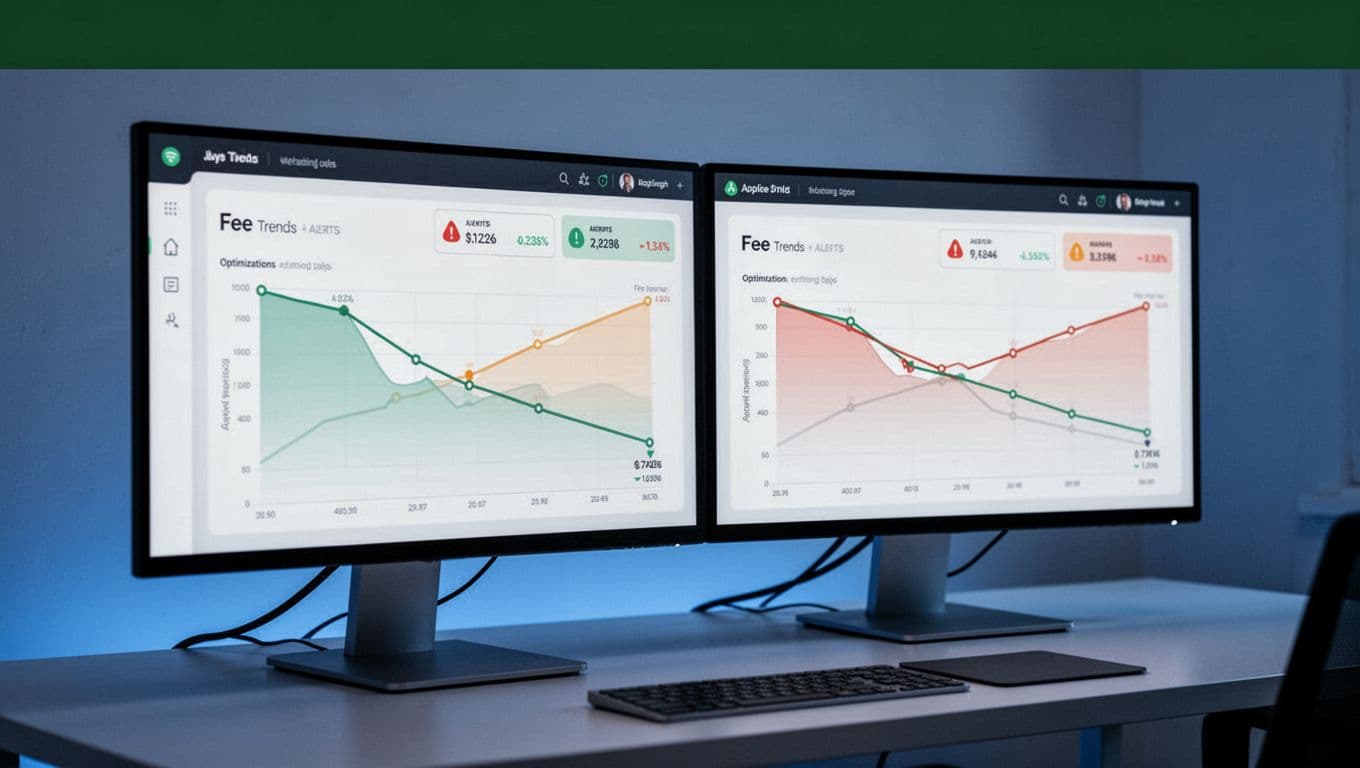
Connect Stripe for AI savings insights. It flags rises. See breakdowns by size. Explore tools to stop overpaying Stripe.
Clean data flows into accounting software or an ERP system, simplifying reconciliation and enabling precise cost allocation, your ultimate ongoing wins.
Analyze My Fees today. Get your effective rate and plan.
Frequently Asked Questions
What is invoice consolidation?
Invoice consolidation merges multiple charges—like subscriptions, add-ons, and usage overages—into a single invoice per billing cycle. Customers pay once with an itemized breakdown, cutting Stripe flat fees and invoicing fees. Stripe Billing handles this natively for B2B SaaS.
How much can B2B SaaS save with invoice consolidation?
For a $500 annual customer, separate monthly invoices cost $6 in extra fees; one consolidated invoice drops it to $2.30—a $3.70 save per customer. Scale to 1,000 customers for $3,700 yearly. Effective rates fall 0.2-0.5%, stacking with ACH for more.
How do I implement invoice consolidation in Stripe?
Group line items by billing cycle in your Stripe Billing setup or tools like Maxio. Customers receive one statement with one due date. Test on high-volume clients first, then monitor via Stripe dashboards.
Does invoice consolidation impact revenue recognition?
No—revenue recognition stays the same as you still bill for the same periods and amounts. It just simplifies delivery and cuts fees. B2B accounting flows unchanged into your ERP.
Is invoice consolidation right for my SaaS?
Ideal for high-ACV B2B with usage-based or annual plans; less so for tiny micro-transactions. Customers love fewer invoices, improving experience and reducing late payments. Pair with monitoring tools for max wins.
Key Takeaways
Consolidated invoicing slashes flat fees and invoicing costs. B2B SaaS sees quick wins on high-volume customers with better cash flow management and administrative efficiency. Combine it with ACH and monitoring for 1-2% effective rate drops.
Your margins improve right away. Simplifying the process reduces the likelihood of late payments. Test it on one segment. Watch the numbers fall. Fees won't control your growth anymore.